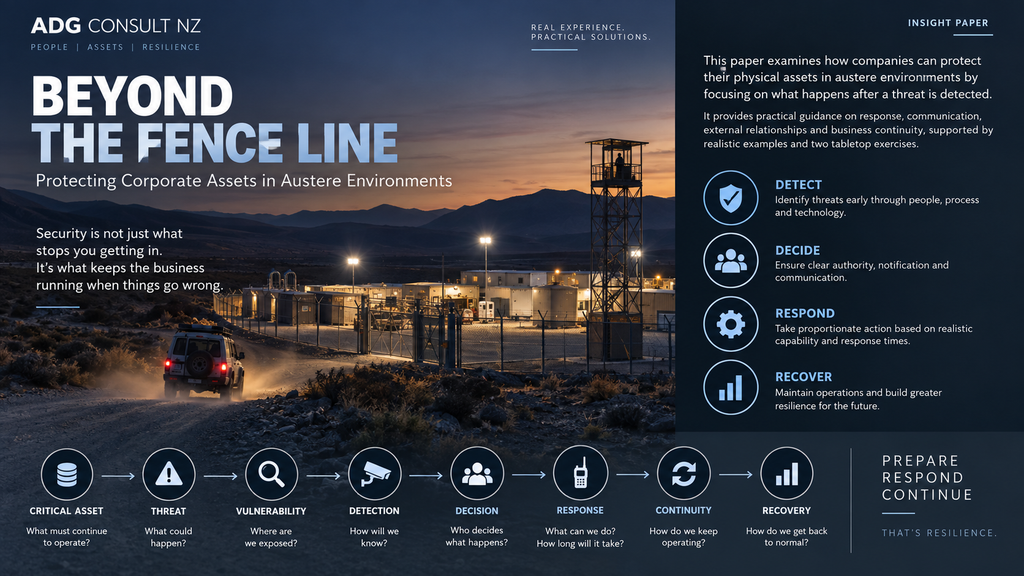
Beyond the Fence Line: Protecting Corporate Assets in Austere Environments examines why effective corporate security must extend beyond fences, guards, cameras and alarms. The paper focuses on a common weakness in physical protection: organisations may detect a threat quickly but still lack a clear process for deciding what happens next.
It explores asset criticality, layered security, contractor and insider risk, remote-site vulnerabilities, emergency communications, external responder relationships, realistic response times, business continuity and recovery. Particular emphasis is placed on the period between detection and the arrival of authorised assistance—who verifies the incident, who is informed, who has authority to act, what staff and guards are expected to do, and how the organisation continues operating while support is still en route.
Supported by practical corporate examples and two tabletop exercises, the paper argues that true security capability is measured not simply by what an organisation can prevent or detect, but by how effectively it can respond, maintain continuity and recover when something goes wrong.